
Reflections from an Pediatric Dysphagia Specialist
Speech-Language Pathologist shares her story about having the opportunity to present at the largest hospital in West Africa, the Korle-Bu Teaching Hospital in Accra, Ghana.

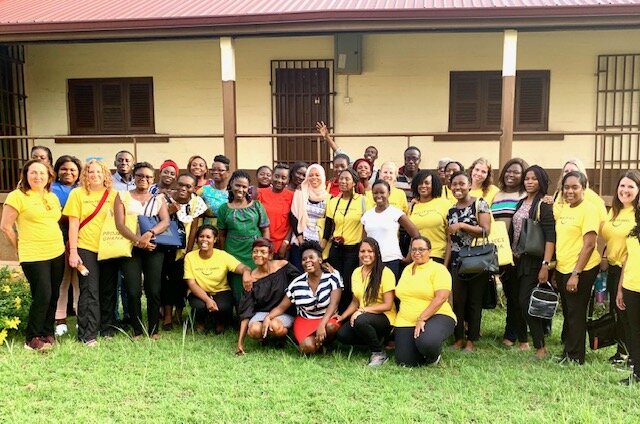
When I think about the highlights from Project Ghana 2019, I immediately think about the opportunity I had to present at the largest hospital in West Africa, the Korle-Bu Teaching Hospital (KBTH)!! Smiles for Speech (SFS) partnered with Nana Akua Owusu, a true pioneer in the field of Speech-Pathology in Ghana to organize this important event. It was such an honor after 25 years in the field and training and working with Debra Beckman, creator of Beckman Oral Motor Intervention, to share my of experience to help support families with children with special needs in Ghana.

The lecture hall was full of Speech-Language Pathologists (SLPs), Speech- Language Therapists (SLTs), and SLT students. The presentation was held in the afternoon after a full day training SLT students earlier that day. I knew I was presenting on a topic that is sometimes daunting to many, and occurred at a time when tiredness and weariness were present. My initial question to the group was: “What is the best way to eat an elephant? Answer: “One bite at a time”. That was my approach to the presentation and to the subject matter itself.
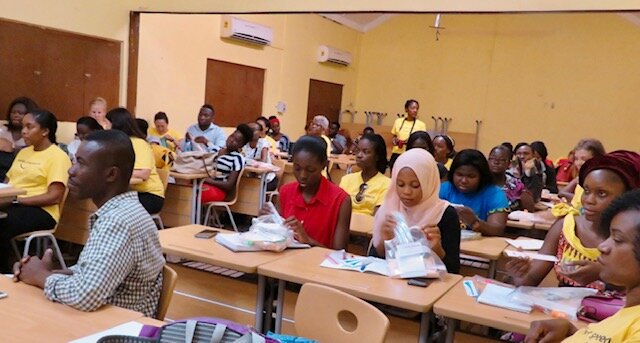
In order to keep over 50 participants engaged for 2 ½ hours, I decided to present the information like a 3 course meal with breaks in between to let the participants savor and digest each “bite”. Dysphagia has 3 stages and I focused on the 1st stage- the Oral Phase. Since the Oral Phase can be assessed and treated in any setting, I thought this would be the best place to start and the most beneficial for children and families in Ghana. If we are able to strengthen oral motor function, reduce drooling, increase chewing skills, and improve nutritional intake, this would be most impactful.

With team member/ SLP, Darlene Warner, we shared the “Tools of the Trade” which included a hands on demonstration of the use of the therapy materials. With the help of my colleagues/SLPs Wanda Ewing and Pamela Tatum from Houston, Texas, we were able to provide 40 Oral Motor/Swallowing Kits for the SLT students in Ghana. The kit included my “must have” items: flashlights, bubbles, flavored tongue depressors, chewy tubes, maroon spoons, a pad to use as mat or bib, toothbrushes, and cloth bands. I shared an inexpensive technique to adapt the spoon using a simple rubber band/hair tie to assist children with Cerebral Palsy or others that have difficulty with grip control.

The last activity participants engaged in was to complete the phrase: “I will start (using the new skill) by (date) ” and share this with their neighbor. This moment was for all to take the time to reflect and process the experience. When learning new information, it is extremely important to not only to absorb but also plan to implement the new strategies. We are grateful to Nancy B. Swigert for the donation of 6 copies of her text book Pediatric Dysphagia Link to be held at the University of Ghana for students to use as a reference.

Thank you to the Smiles for Speech team and Nana Akua Owusu and for giving me an opportunity to renew my passion for the field and prayerfully continue for another 25 years!


Miracles in Ghana
A Swedish Speech-Language Therapist connects with a family from Sweden and realizes her work and time spent in Ghana was not a coincidence.

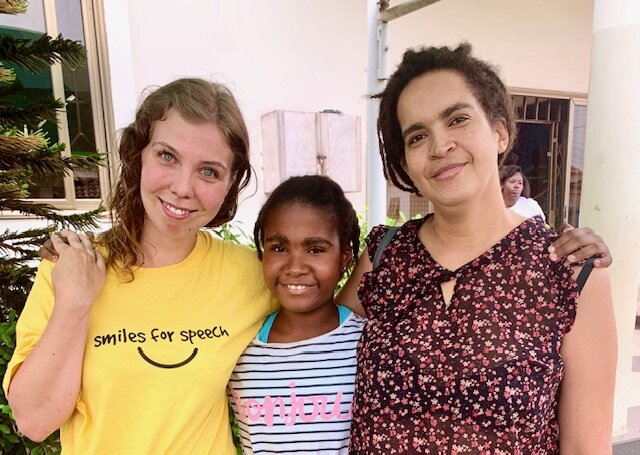
One week into my trip with Smiles For Speech, I experienced a meeting that made me feel that it was really meant for me to be on the trip.
When I arrived on the bus, Tuesday morning, our team leader, Sandy read through the consultations to be distributed among the team. She offered an 8-year-old with hearing impairment, a 6-year-old with autism, a 10-year-old with reading and writing difficulties and several other cases. At first, I sat quietly. I was a little tired after the intense days and thought to myself, I should keep a low profile this day. But then I started thinking that I should still take the consultation if it was centered reading and writing. Sandy lists the cases again and I said, “I'll take it. It will be fine. I have worked with alot of reading and writing difficulties in my work and I also teach it at the speech therapy program back home in Umea, Sweden.”
Like all of the other days, the experience joining the team to arrive for the school visit is intense and warm (in terms of temperature but also emotionally). After a mentoring and guiding the speech therapy students in the early part of the day, it was time for me to start the individual consultations.
I met the parent and child in a classroom. We greeted each other and sat down. The child went to pick up something and I started asking the parent what they needed help with and asked about background information to better provide advice and guidance. Mom said that they have tried to seek help in the past but that they have had challenges receiving support and contradictory advice about the child's language development because they are multilingual.
To my surprise, this is how the conversation went:
Mom: "Yes, we moved from Sweden when she was four."
Me: "From Sweden ??" (I was totally surprised)
Mom: "Yes"
Me: "But I am from Sweden?" (I respond with a big smile and here the conversation switches from English to Swedish)
Mom: "WHAT, are you kidding me - are you Swedish?" (She was even more surprised than me!)
Me: "Yes, I'm Swedish. The others are from the US but I'm from Sweden "
The parent started to laugh and shook her head in disbelief, "But, it can't be true, how can this be true?
The feeling was almost indescribable. We both gasped and could not believe that it was true. How could I be a Swedish speech- language pathologist, traveling with an American volunteer organization to Ghana by some kind of coincidence, meet a Swedish family that needed my advice and support.
Mom was astonished and amazed. She rushed to find the school principal and and she to ask if she knew about this.
Mom: "Did you set this up? Did you know she's Swedish?"
We continued our conversation still switching between Swedish and English. We spent time talking about holidays in Sweden and the schools in Sweden compared to the schools in Ghana. In between, I provided advice on continued reading training and compensatory aids for reading and writing.
The rest of the day was filled with wonder and joy each time I stopped to think about what just happened. No one really knew the whole story but deep down inside I knew it was meant to be.
